CONTACT US

What if the most dangerous threat to your company’s continuity isn’t a visible break-in, but a silent, unpatched vulnerability in your network? While many leaders focus on physical locks or digital firewalls in isolation, the reality of 2026 is that these systems are now deeply intertwined. Organizations that leverage managed services often reduce their overall IT costs by 20% to 30% while significantly boosting productivity. Implementing professional remote monitoring management for business allows you to bridge the gap between your structural cabling and your digital uptime, creating a single point of truth for your entire infrastructure.
It’s exhausting to juggle fifteen to twenty different vendors for your cameras, access control, and server maintenance. You want the peace of mind that comes from knowing your systems are being watched by a reliable architect who values long-term stability over quick fixes. This guide provides a clear path to total visibility and lower operational costs through proactive protection. We’ll examine how AI-driven automation and new compliance standards like CMMC and CPPA are shaping the future of business resilience, giving you the tools to stop reacting to failures and start preventing them before they impact your bottom line.
Key Takeaways
- Understand why the traditional “break-fix” model creates hidden vulnerabilities and how shifting to proactive oversight prevents minor glitches from cascading into total system failures.
- Learn how professional remote monitoring management for business provides a unified view of your structural cabling and digital network to ensure uninterrupted continuity.
- Evaluate the true cost of the “DIY” software trap and discover why managed monitoring services offer a more sustainable path to stability than managing complex platforms internally.
- Gain a practical roadmap for auditing your facility’s infrastructure to identify single points of failure in your cabling, security, and power systems.
- Discover the benefits of integrating cloud-based surveillance and access control with your IT infrastructure to create a comprehensive, resilient commercial environment.
Table of Contents
- Why Reactive IT is the Greatest Threat to Your Business Continuity
- Decoding RMM: How Remote Monitoring Protects Your Commercial Infrastructure
- RMM Software vs. Managed Monitoring Services: Choosing the Right Model
- A Strategic Roadmap for Implementing Remote Monitoring in Your Facility
- Securing Your Southern California Operations with Terapixels RMM
Why Reactive IT is the Greatest Threat to Your Business Continuity
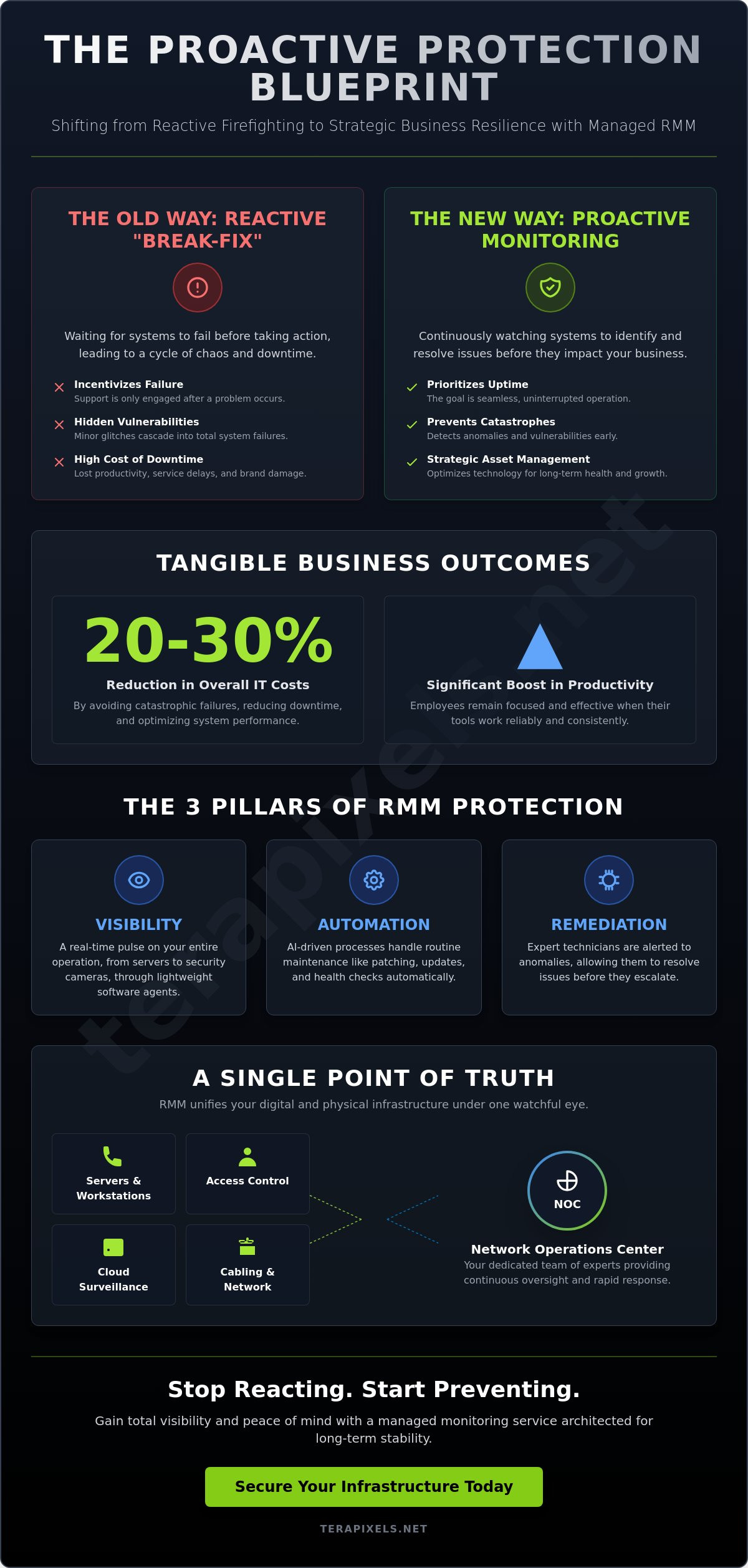
The traditional break-fix model is a relic that no longer serves the needs of a modern commercial enterprise. Waiting for a system to fail before addressing it creates a cycle of reactive chaos that drains resources and prevents strategic growth. In 2026, remote monitoring management for business has evolved from a technical luxury into a foundational requirement for operational stability. When you rely on reactive support, you aren’t just paying for a repair. You’re paying for the lost productivity of every employee, the delayed delivery of services, and the silent degradation of your hardware. This model is inherently flawed because it incentivizes failure rather than uptime.
This approach often ignores the reality that minor network glitches are rarely isolated events. Instead, they frequently act as the first domino in a cascade of failures. For example, a simple unpatched server can become the entry point for a significant security breach. Remote monitoring and management (RMM) provides the framework to identify these vulnerabilities before they can be exploited. Without this proactive oversight, your leadership team remains trapped in a state of constant firefighting. The psychological toll of this uncertainty is heavy. It’s difficult to focus on long-term vision when you’re perpetually worried about the next system crash or security lapse.
The Anatomy of a Business Interruption
Consider the typical path of a facility interruption. A single network switch fails due to an overlooked firmware update or a cooling issue. Suddenly, your cloud-based access control systems lose connectivity, potentially locking employees out of critical areas. Simultaneously, your cloud-based surveillance systems stop recording, creating immediate blind spots in your physical security. This isn’t just a technical hurdle; it’s a direct blow to your brand reputation. Customers expect a seamless experience, and a business that cannot operate due to basic infrastructure failures loses trust quickly. While the specific impact varies by industry, organizations that transition to managed models often see a 20% to 30% reduction in overall IT costs by avoiding these catastrophic events.
Moving from Firefighting to Future-Proofing
Resilient businesses view their technology as a strategic asset rather than a simple utility. This shift in mindset requires a move toward a proactive protection model. By establishing a clear baseline for your infrastructure, including your structural cabling and fiber networks, you can detect anomalies the moment they appear. This architectural approach ensures that your systems aren’t just running, but are optimized for long-term health. It allows you to build a partnership with a reliable expert who manages the complex background systems. This steady hand ensures your digital and physical infrastructure remain in sync, providing a level of stability that reactive models simply cannot match. True continuity is a deliberate result of structured, continuous oversight. For those interested in the broader field of informatics and IT systems, reisinformatica.com offers additional insights into maintaining a robust digital environment.
Decoding RMM: How Remote Monitoring Protects Your Commercial Infrastructure
For the modern enterprise, remote monitoring management for business is no longer a standalone software package. It is a comprehensive architectural framework that connects your digital network to your physical facility. This system relies on three core pillars: visibility, automation, and remediation. By deploying lightweight software agents across your servers, workstations, and security hardware, a central Network Operations Center (NOC) gains a real-time pulse on your entire operation. These agents act as a steady hand, communicating vital performance data back to a team of experts who can identify and resolve issues before they disrupt your workflow, while platforms like StatusPulse help translate that technical uptime into transparent communication for your clients.
Unlike traditional IT tools that focus solely on software, a sophisticated RMM approach integrates your physical security assets. Your cloud-based surveillance systems and access control hardware are critical endpoints on your network. If a camera goes offline or a CAT6 cable connection degrades, the RMM system alerts the NOC immediately. This shift toward proactive, centralized, remotely managed operations ensures that your security perimeter and your data integrity are managed as a single, cohesive unit. A well-designed remote monitoring strategy ensures your physical and digital layers work in perfect harmony.
Real-Time Visibility Across Your Entire Facility
True operational resilience begins with total visibility. A professional RMM setup provides a granular view of server health, storage capacity, and bandwidth utilization. It doesn’t stop at the server room door; it monitors the uptime of your cloud-based access control and CCTV systems to prevent security blind spots. By visualizing the performance of your structured cabling and fiber networks, we can identify bottlenecks or physical layer issues that might otherwise go unnoticed until a total failure occurs. This high-level oversight allows you to manage your infrastructure as a complete ecosystem rather than a collection of isolated parts.
Automated Maintenance and Patch Management
Security vulnerabilities often stem from the “vulnerability window” between the release of a patch and its manual installation. Modern remote monitoring management for business eliminates this risk by automating critical security updates across your commercial firewalls and operating systems. This automation doesn’t require human intervention for routine tasks, ensuring your defenses are always current. By scripting repetitive maintenance duties, your internal resources are freed to focus on core business objectives. This methodical approach to patching provides a layer of protection that is both consistent and verifiable, meeting the rigorous demands of 2026 compliance standards.
RMM Software vs. Managed Monitoring Services: Choosing the Right Model
Businesses often fall into the trap of thinking a software license is a complete solution. While 62% of RMM installations are now cloud-based, owning the platform is only the first step toward true resilience. Effective remote monitoring management for business requires more than just a dashboard; it requires a seasoned architect to interpret the data and act upon it. When you manage an RMM platform internally, you assume the full burden of labor, continuous training, and constant system updates. For many commercial properties in Orange County, this creates a significant drain on resources that could be better spent on core growth objectives.
A managed monitoring service shifts this responsibility to a specialized partner. This partnership model provides a steady hand to oversee your structural cabling, cyber security, and cloud-based surveillance. Instead of your staff struggling to keep up with tool sprawl, you gain a unified system designed for long-term stability. This approach allows your infrastructure to scale seamlessly as your facility expands, ensuring your protection remains comprehensive without the need to constantly hire and retrain internal IT personnel. Organizations that partner with managed service providers often reduce their overall IT costs by 20% to 30% through these efficiencies.
The Expertise Gap in Modern Cybersecurity
The threat landscape of 2026 is increasingly complex, with new regulations like the Cybersecurity Maturity Model Certification (CMMC) and CPPA finalized in late 2025. These mandates require a level of demonstrated maturity that goes beyond simple automated alerts. There’s a fundamental difference between receiving a notification of a failed login and having a security analyst resolve a potential breach in real-time. By leveraging a managed service provider, you bridge this expertise gap. You gain access to professionals who understand how to integrate AI analytics with your physical security systems, ensuring every incident is not just detected, but fully remediated according to modern standards. For smaller operations especially, establishing robust network security for small business is a critical foundation before layering on more advanced monitoring capabilities.
Total Cost of Ownership (TCO) Analysis
When evaluating the choice between standalone software and a service model, the financial picture becomes clear through a TCO lens. While software licensing fees might seem lower initially, they don’t account for the hidden costs of internal management, such as employee turnover or the time lost to manual patch management. A predictable, flat-rate managed agreement provides a better return on investment by preventing the catastrophic costs of downtime.
- ROI of Prevention: A single ransomware incident or hardware failure can cost far more than years of proactive monitoring.
- Predictable Budgeting: Managed services eliminate the financial spikes associated with emergency repairs and unbudgeted tool upgrades.
- Resource Optimization: Your internal team can focus on high-value projects while the background systems are managed with precision.
Choosing a managed model ensures your business continuity is built on a foundation of expert oversight rather than just a collection of software tools. This architectural approach provides the peace of mind that your facility is protected by a partner who shares your goals for growth and stability.
A Strategic Roadmap for Implementing Remote Monitoring in Your Facility
Implementing remote monitoring management for business requires a methodical approach that respects both your digital network and your physical facility. It isn’t enough to simply install software. You must design a system that bridges the gap between your server racks and your entry points. This process begins with a comprehensive audit of your existing infrastructure. We examine your CAT6 and fiber cabling, server health, and current security hardware to establish a baseline of operational health. By identifying “Single Points of Failure,” such as a non-redundant switch or an unmonitored backup generator, we can build a strategy that prevents minor issues from becoming operational disasters. It’s about precision.
Once the audit is complete, we deploy RMM agents and integrate your cloud-based surveillance systems into a single pane of glass. This integration ensures that your security cameras and access control points are monitored with the same rigor as your primary data servers. We then establish specific performance thresholds and escalation protocols. This means every alert has a predetermined path for remediation, moving from automated resolution to expert intervention when necessary. Monthly analytics reports provide the final piece of the puzzle, offering the data needed to optimize your systems for long-term health. If you’re ready to secure your facility, you can explore our comprehensive RMM solutions today.
Prioritizing Your Critical Assets
Effective business continuity planning depends on knowing which assets are most vital to your daily operations. We focus on high-traffic access control points and your fiber backbone, as these are the arteries of your facility. It’s equally important to bring your backup power systems into the monitoring loop. If a generator fails during a utility outage, your entire security perimeter could be compromised. For Southern California businesses facing increasing Public Safety Power Shutoffs, a professional backup generator installation for business is a critical component of any comprehensive continuity plan. By aligning our monitoring goals with your specific business continuity plan, we ensure that the most critical links in your chain receive the highest level of oversight. This includes monitoring the health of specialized infrastructure like EV chargers and commercial solar arrays to ensure they remain functional and efficient.
Establishing the Escalation Matrix
A robust monitoring system is only as good as the response it triggers. We work with you to define a clear escalation matrix that answers the critical question: who is responsible when a threshold is crossed? This isn’t just about sending an alert; it’s about having a protocol that ensures a resolved incident. We leverage AI analytics to filter out noise and reduce alert fatigue, ensuring that your team and our experts only focus on genuine threats. This data-driven approach allows for continuous improvement, as monthly reports highlight areas where infrastructure upgrades can further enhance your resilience. It’s a steady, building-block approach to total technological reliability.
Securing Your Southern California Operations with Terapixels RMM
Terapixels Systems serves as a singular source of truth for commercial properties across Southern California. Our approach to remote monitoring management for business is built on the understanding that digital uptime is inextricably linked to physical infrastructure. We don’t just look at software health. We monitor the entire ecosystem, from the fiber optics in your walls to the AI analytics protecting your perimeter. This comprehensive oversight ensures that your networking, security, and power systems function as a unified, resilient whole. By acting as your Reliable Architect, we provide the steady hand needed to manage complex background systems so you can focus on your core objectives.
For businesses in San Diego and Orange County, localized expertise is a critical differentiator. We understand the specific operational demands of regional commercial hubs and the technical requirements of modern facility management. Our AI-driven analytics enhance both site security and digital uptime by identifying patterns that human observers might miss. Whether it’s detecting an anomaly in your cloud-based surveillance or predicting a failure in your backup generator, our systems provide the foresight necessary to maintain continuity. This partnership-driven mindset creates a symbiotic relationship where your growth is supported by our technical precision.
Comprehensive Integration from Fiber to Cloud
We believe that a resilient network starts at the physical layer. This is why we monitor structural cabling and fiber connections with the same rigor we apply to cybersecurity protocols. If a CAT6 connection begins to degrade or a network switch shows signs of heat stress, our system identifies the issue before it leads to a total facility lockout. We ensure your cloud-based access control remains online and responsive, providing facility managers with customized RMM dashboards tailored to their specific needs. This level of detail eliminates the tool sprawl that often plagues growing enterprises, replacing disconnected vendors with one integrated source of truth.
Ready for the Next Step in Business Resilience?
The transition from reactive stress to proactive stability begins with a professional site audit and infrastructure assessment. We conduct a thorough review of your current systems, identifying vulnerabilities in your cabling, security, and backup power layers. By bringing your commercial solar arrays and EV chargers into the monitoring loop, we create a truly comprehensive continuity plan that addresses the realities of 2026. It’s time to move away from the uncertainty of the break-fix model and embrace a foundation of technological reliability. A structured, well-managed environment is the only way to ensure your business never stops.
You can schedule your Terapixels Systems consultation today to discover how our integrated approach protects your Southern California enterprise.
Building a Foundation for Uninterrupted Growth
Transitioning from reactive firefighting to a state of proactive stability is the most significant step you can take to protect your commercial operations. By integrating your physical security, including cloud-based surveillance and access control, with your digital network health, you create a resilient environment ready for the complexities of 2026. Professional remote monitoring management for business ensures that your structural cabling, fiber networks, and AI-driven security systems are managed by a reliable architect who values long-term precision over quick fixes.
Terapixels Systems provides full design-to-maintenance lifecycle support, ensuring your infrastructure remains optimized as your facility scales. Our expertise in CAT6, fiber, and AI-driven security is backed by a dedicated local presence in San Diego and Orange County. We’re committed to acting as your steady hand, managing the complex background systems so you can focus on your core objectives. Secure Your Infrastructure with Terapixels Remote Monitoring today. It’s time to build a more stable and secure future for your business together.
Frequently Asked Questions
What is the difference between RMM and traditional IT support?
Traditional IT support typically operates on a reactive break-fix model where issues are addressed only after a failure occurs. In contrast, remote monitoring management for business focuses on proactive prevention by using software agents to track system health in real-time. This architectural approach identifies vulnerabilities and performance bottlenecks before they disrupt your operations, allowing for a more stable and predictable environment compared to waiting for a system to crash.
Can RMM monitor physical security cameras and access control systems?
Yes, professional RMM services are designed to integrate with your cloud-based surveillance and access control systems. We monitor the connectivity and uptime of your CCTV cameras and entry points just as we do with your data servers. This ensures that your physical security perimeter remains active and that any hardware failures or network drops are identified immediately, preventing dangerous blind spots in your facility’s protection.
Is remote monitoring management secure for sensitive business data?
Remote monitoring management is highly secure and utilizes encrypted communication channels to protect your sensitive operational data. The system focuses on performance metrics and system health rather than the content of your private files. By maintaining consistent patch management and monitoring for unauthorized access attempts, RMM actually strengthens your overall cyber security posture by ensuring your defensive tools are always updated and functional.
How does RMM help with regulatory compliance in California?
RMM assists with California’s regulatory landscape, such as CPPA requirements, by providing automated reporting and verifiable security audits. These systems ensure that your data protection measures are consistently applied and documented, which is essential for demonstrating compliance. By maintaining a steady hand over your infrastructure, you can meet the rigorous demands of new privacy laws and cybersecurity maturity certifications without the need for constant manual oversight.
Do I need to replace my existing hardware to use RMM services?
You typically don’t need to replace your existing hardware to implement RMM services. The system is designed to layer over your current infrastructure, including your servers, workstations, and networking equipment. We conduct an initial audit to ensure your fiber and CAT6 cabling can support the monitoring agents, but the goal is to enhance and protect your current investment rather than requiring a total hardware overhaul.
What happens if the RMM system detects a critical failure overnight?
If the system detects a critical failure outside of standard business hours, it automatically triggers an alert to our central Network Operations Center (NOC). This allows for immediate remediation protocols to begin, often resolving the issue remotely before your team arrives the next morning. This continuous oversight provides the peace of mind that your business continuity is being protected even when your facility is closed.
How does RMM reduce the long-term cost of structured cabling maintenance?
RMM reduces cabling maintenance costs by identifying signal degradation and physical layer errors before they lead to a total network outage. By tracking the performance of your structured cabling, we can pinpoint specific areas that require attention, preventing the need for emergency repairs or full-scale cable replacements. This methodical approach extends the lifespan of your infrastructure and ensures your high-speed fiber remains optimized for peak performance.
Can RMM integrate with our commercial solar and EV charging infrastructure?
Yes, Terapixels RMM can integrate with your commercial solar and EV charging infrastructure to provide a unified view of your facility’s energy and tech systems. We monitor the health and output of these components to ensure they are contributing to your operational efficiency as intended. This level of integration allows facility managers to oversee their entire technological footprint from a single, organized dashboard that tracks everything from power to security.