Improve entry awareness
Connect video, intercom, credentials, schedules, and door or gate events so staff can identify and manage visitors consistently.
 Request an estimate
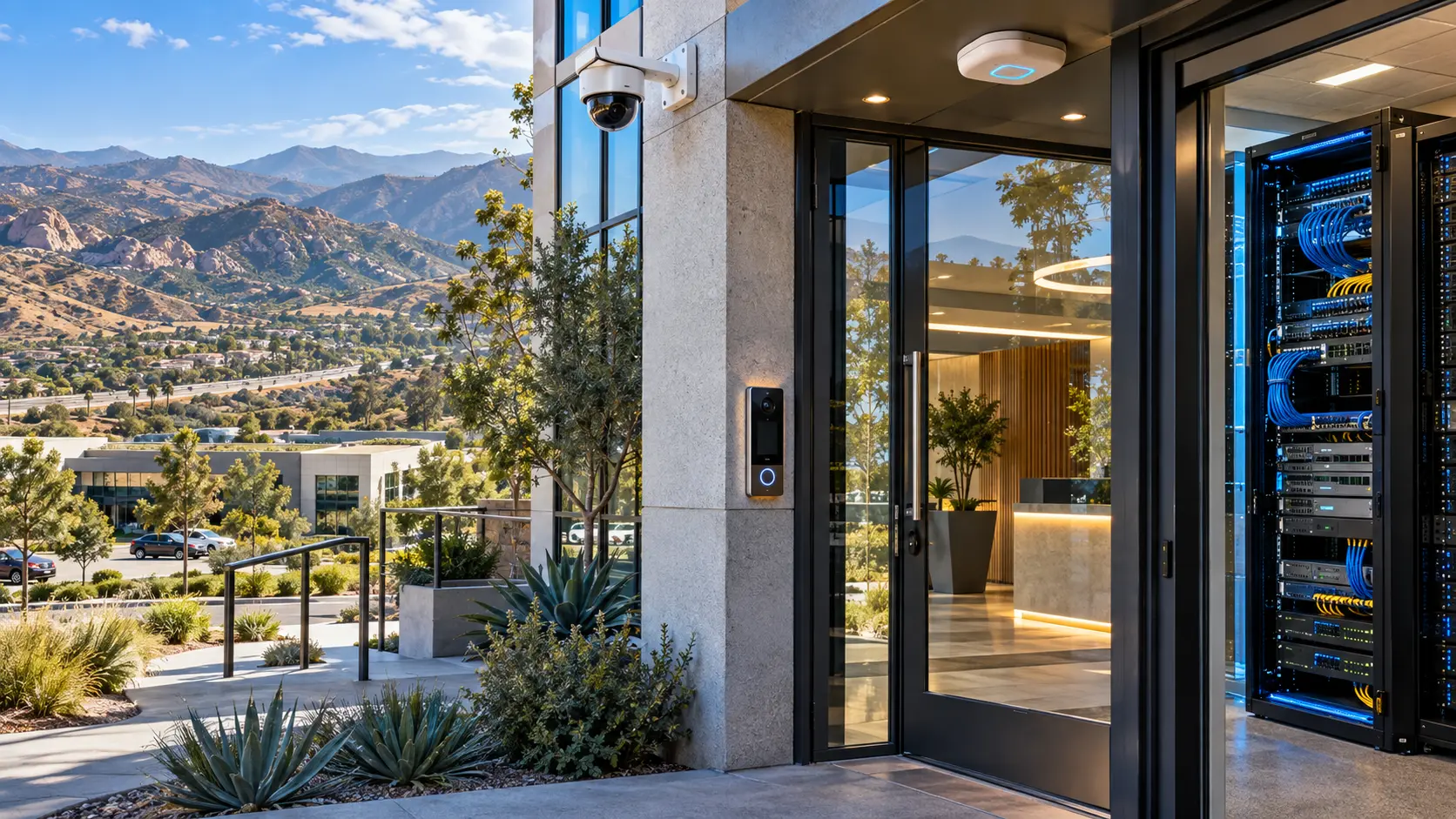
Terapixels provides commercial video, access control, intercom, cabling, fiber, Wi-Fi, network, cloud, and IT systems for Calimesa offices, clinics, retail, schools, community properties, and light industrial operations.
A Calimesa project can bring security, connectivity, and support under one coordinated scope. We assess the building and workflows, then align cameras, controlled openings, pathways, racks, switching, wireless coverage, software, cloud administration, documentation, and ongoing service.
Select a capability for technical details, platforms, deliverables, and planning questions.
IP cameras, video management, cloud or on-premises recording, analytics, retention planning, and investigation workflows.
Explore capability ↗Credentials, readers, controllers, electrified hardware, permissions, reporting, and cloud or on-premises administration.
Explore capability ↗Copper, fiber, pathways, racks, MDF and IDF buildouts, testing, labeling, remediation, and as-built documentation.
Explore capability ↗Switching, routing, firewalls, segmentation, wireless design, cloud connectivity, monitoring, and performance validation.
Explore capability ↗Help desk, onsite support, Microsoft 365, endpoints, backup, cybersecurity, servers, cloud systems, and technology planning.
Explore capability ↗Troubleshooting, system-health review, documentation, training, upgrades, licensing coordination, and lifecycle support.
Explore capability ↗Calimesa combines established neighborhoods, newer commercial development, healthcare and professional services, education, retail, community facilities, and properties influenced by the I-10 corridor and San Timoteo Canyon. Sites may be compact storefronts or spread across multiple buildings and outdoor areas.
The technology plan should account for entrances, parking, deliveries, employee areas, public access, telecom-room condition, wireless reach, hillside or canyon exposure, future expansion, and who will administer and support the system after turnover.
Connect video, intercom, credentials, schedules, and door or gate events so staff can identify and manage visitors consistently.
Organize racks, patching, labels, cable pathways, switching, power, grounding, documentation, and abandoned cabling before adding devices.
Plan access-point placement, capacity, roaming, outdoor reach, segmentation, cabling, and post-installation testing.
Leave documented capacity in pathways, racks, fiber, switching, PoE, licensing, storage, and cloud subscriptions.
Visitor entry, credentials, parking coverage, tenant networks, Wi-Fi, and lifecycle support for Calimesa workplaces and properties.
Reliable entry, discreet video, protected infrastructure, wireless coverage, and carefully scheduled work for Calimesa care environments.
Customer-aware video, staff access, inventory protection, guest connectivity, and after-hours response for Calimesa commercial destinations.
Campus entry, visitor workflows, video, classroom connectivity, cabling, and support coordinated around occupied Calimesa learning environments.
The scope is defined around the site, existing assets, users, risks, operational schedule, technology dependencies, and outcome—not a predetermined product bundle.
Yes. We can document the current environment, identify dependencies, prioritize risks, define the target architecture, and phase cabling, network, security, and cloud changes around operations and budget.
They can share managed infrastructure when capacity, segmentation, cybersecurity, PoE, QoS where needed, addressing, monitoring, ownership, and support responsibilities are designed intentionally.
Terapixels provides video surveillance, access control, intercom and entry, intrusion integration, structured cabling, fiber, network infrastructure, commercial Wi-Fi, cloud and server systems, managed IT, documentation, and lifecycle support for Calimesa organizations.
Yes. Project planning can account for operating hours, public and staff circulation, restricted spaces, temporary protection, testing, training, and approved migration windows to reduce disruption.