
Clear answers before you choose a system.
Practical guidance for commercial cameras, access control, structured cabling, fiber, networks, Wi-Fi, cloud systems, and managed IT—written for the people who plan, operate, and approve the work.
Short answer first.
Useful detail next.
Each response begins with the practical answer, explains what changes the recommendation, and connects you to the relevant Terapixels service. Product-specific behavior is confirmed during design because platforms and site conditions differ.
What are you planning?



How many security cameras does a business need?+
There is no reliable camera count without a coverage plan. The right number depends on entrances, parking, transaction areas, loading zones, lighting, identification distance, blind spots, risk, and the views your team needs during an investigation. See our video surveillance approach.
How much video storage does a business need?+
Storage is calculated from camera count, resolution, frame rate, compression, scene activity, recording schedule, redundancy, and retention days. Start with the business or compliance retention objective, then size the storage—rather than choosing a recorder first and accepting whatever retention it produces.
Should we use cloud, on-premises, or hybrid video surveillance?+
Cloud video can simplify remote access and multi-site administration; on-premises systems can offer greater local control and specific integration options. A hybrid design can combine local recording with cloud management or backup. The best fit depends on bandwidth, cybersecurity policy, retention, integrations, ownership, and operating model.
Can existing security cameras be reused?+
Often, but only after compatibility and condition are verified. We evaluate image quality, supported protocols, firmware, cybersecurity, licensing, power, network capacity, mounting, and compatibility with the proposed video platform before recommending reuse, migration, or replacement.
What is included in a commercial access control system?+
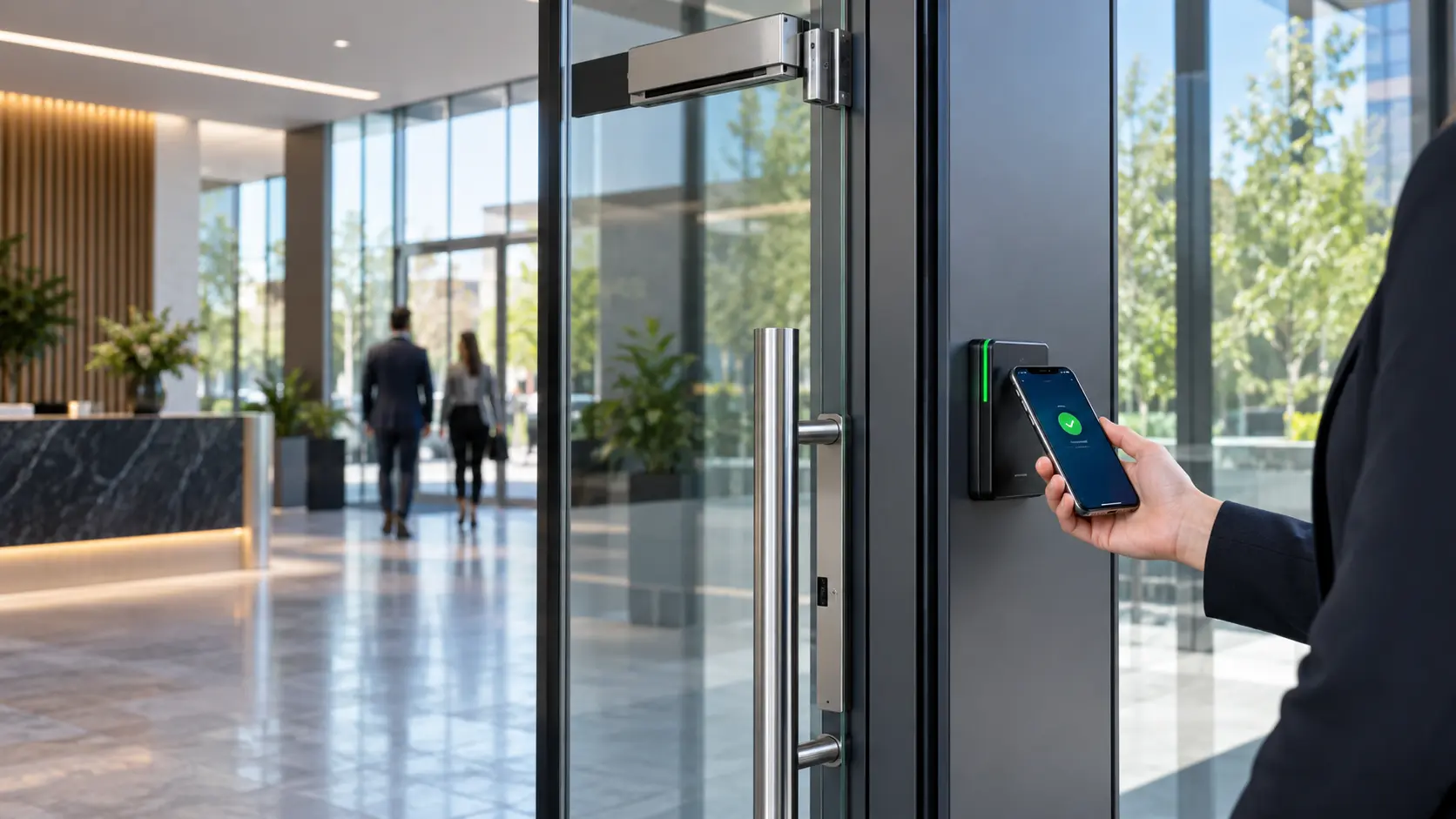
A complete system can include readers, credentials, controllers, power supplies, locks, request-to-exit devices, door-position switches, cabling, software, permissions, reporting, testing, training, and documentation. Door hardware and life-safety conditions must be reviewed as part of the design. Explore access control.
Can access control integrate with cameras and intercoms?+
Yes. When supported by the selected platforms, door events can be associated with video, and an intercom call can support visual verification before a door is released. Integration requirements should be defined before products are selected. See intercom and video entry.
What happens to cloud access control if the internet goes down?+
Many commercial controllers can continue making local access decisions from synchronized credentials and schedules, while remote management and cloud reporting may be temporarily unavailable. Exact offline behavior varies by platform, controller, configuration, and lock, so it must be verified during design and commissioning.
Which lock or electrified door hardware should we use?+
The opening, door and frame, traffic, code requirements, egress method, fire rating, power condition, monitoring needs, and desired fail-safe or fail-secure behavior determine the hardware. A qualified door survey should happen before the system is quoted.
Should a business install Cat6 or Cat6A cabling?+
Cat6 is appropriate for many standard office applications. Cat6A is often chosen for 10-gigabit performance to 100 meters, higher-power PoE planning, or a longer infrastructure lifecycle, but it requires more pathway and termination space. The choice should follow distance, application, environment, bundle size, and budget—not a blanket rule.
When should fiber be used instead of copper?+
Fiber is typically used for building backbones, long distances, high bandwidth, electrical isolation, campus links, and environments with electromagnetic interference. Copper remains practical for many endpoint connections and PoE devices. Explore fiber-optic cabling.
Can an occupied office be recabled without shutting down?+
Usually, yes. Work can be phased by area, scheduled around operating hours, and coordinated with furniture, ceiling access, pathways, network cutovers, and occupant safety. The plan should identify any short service interruptions before installation begins.
What documentation should come with a cabling project?+
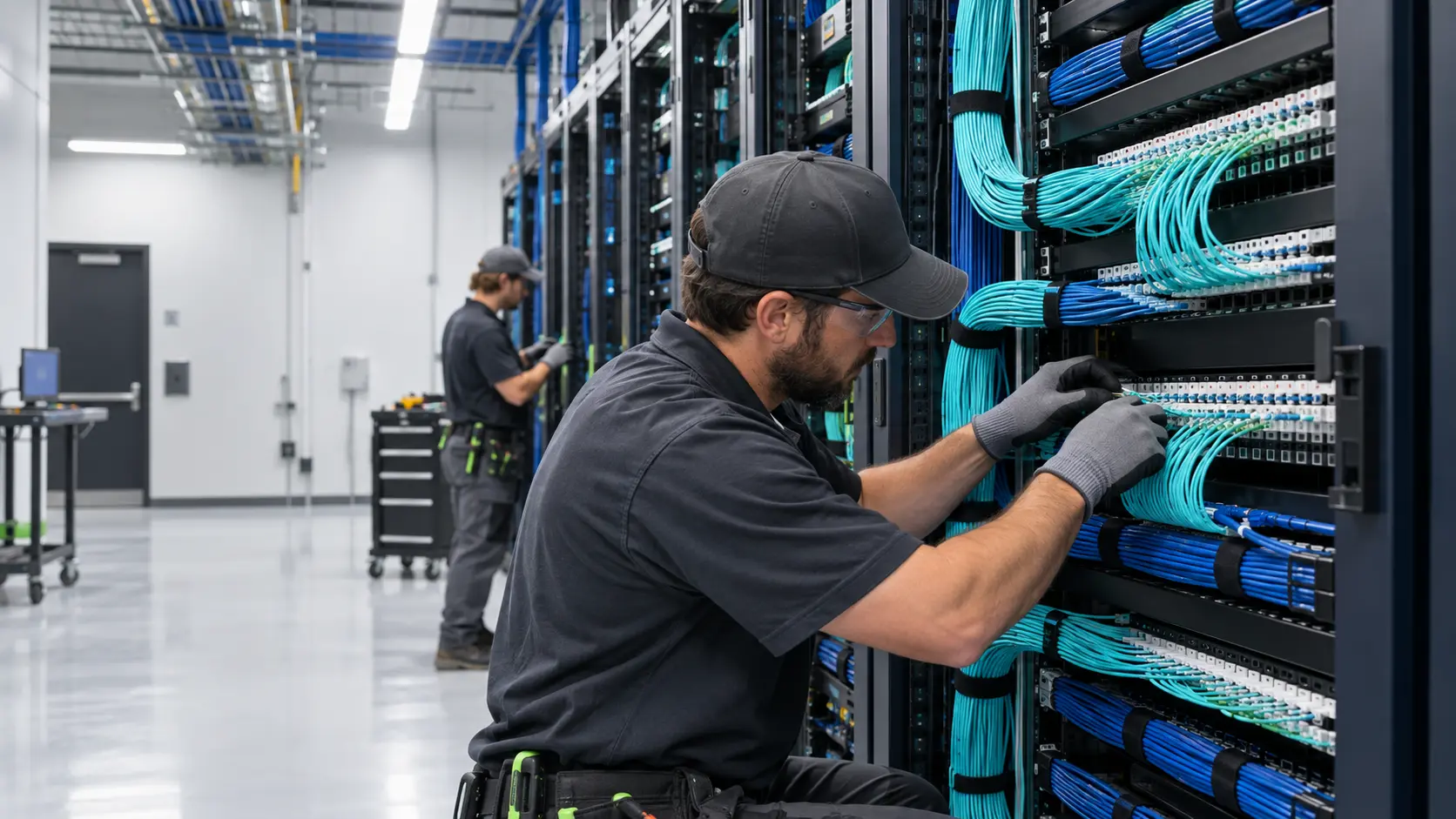
Closeout should match the contracted scope and may include permanent labels, port records, certification test results, rack elevations, pathway notes, photographs, warranty information, and as-built drawings. Clear records make troubleshooting, moves, and future expansion faster.
What does a commercial Wi-Fi project include?+
A sound Wi-Fi project can include requirements discovery, predictive design, onsite validation, spectrum review, access-point placement, capacity planning, cabling, switching and PoE review, configuration, security, roaming tests, and post-installation verification. Coverage alone is not the same as usable capacity.
Why separate cameras and access control from the business network?+
Appropriate segmentation can limit unnecessary communication, reduce exposure, improve policy control, and keep device traffic from interfering with business-critical applications. VLANs are one part of the design; firewall policy, identity, monitoring, patching, and administration also matter.
What causes unreliable network video?+
Common causes include inadequate PoE, oversubscribed links, packet loss, poor cabling, incorrect multicast or quality-of-service settings, storage bottlenecks, firmware issues, time synchronization problems, and insufficient server resources. Diagnosis should examine the complete path from camera to client.
Can existing switches and wireless access points be reused?+
Possibly. We review lifecycle status, licensing, supportability, port and PoE capacity, uplinks, security features, configuration access, coverage, performance, and documentation. Reuse is recommended only when the equipment can meet the new design and remain supportable.
What is the difference between managed and co-managed IT?+
Managed IT assigns broad day-to-day responsibility to a provider under an agreed service model. Co-managed IT supplements an internal team with defined capabilities such as help desk, monitoring, cybersecurity, projects, onsite coverage, or specialized expertise. Explore managed IT services.
What is included in a Terapixels site assessment?+
The scope depends on the project, but an assessment can document current systems, coverage, doors, cabling, racks, network capacity, wireless conditions, servers, storage, software, licensing, users, workflows, risks, support gaps, and operational constraints.
Can Terapixels standardize technology across multiple locations?+
Yes. A multi-site program can define approved platforms, naming, network architecture, permissions, documentation, installation standards, commissioning tests, remote administration, spares, and support procedures while accounting for site-specific conditions.
Where does Terapixels provide local service?+
Terapixels serves commercial organizations throughout Orange County, Los Angeles County, San Diego County, Riverside County, and San Bernardino County. Other areas can be evaluated based on project scope.
Go deeper on current planning topics.
The Answers hub helps a buyer orient quickly. These service pages provide more detail for specific projects.
Office Ethernet Jack Retrofitting
Practical considerations for adding and relocating network drops in occupied commercial spaces.
Explore the service ↗VIDEO · STORAGECCTV Camera Storage for Business
A deeper look at the variables that shape retention, architecture, and storage planning.
Explore the service ↗CABLING · NETWORKCat6 vs. Cat6A for Office Networks
Planning considerations for performance, PoE, pathways, cost, and infrastructure lifecycle.
Explore the service ↗Answers become a plan at your facility.
Explore county and city pages for local service context, then schedule an assessment for recommendations based on the actual site.